





Your guide to understanding inguinal hernias
Published: 03.07.25
Does My Hernia Need Repair?
A Helpful NHS Tool to Support Your Decision-Making
What is a groin hernia?
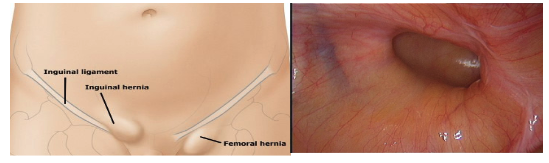
A groin hernia (inguinal, femoral or obturator) is a weakness in the muscle wall in your groin. This can manifest via the bulging of your bowel and/or other structures through the weakness, or sometime as dull aching sensations.The abdominal wall is made up of a sheet of muscles that run down from your ribs to your groin. It acts as a wall holding all the structures of your abdomen, such as bowels, bladder and the fat inside your abdomen.
How does an inguinal/ femoral hernia develop?
There is no definitive cause of hernia but there are plenty of risk factors for the process of development of inguinal hernia. i.e some people are born with a weakness in their groin, while others develop a weakness over time. The weakness or opening of a gap in the muscle can happen of its own accord at a point of natural weakness, or by overstretching or over- exertion (straining). Lifting heavy weights, heavy exercise, or a simple cough or sneeze are the main risk factors for development of hernia.How do I know if I have hernia?
Some of the symptoms are:- A bulge under the skin
- Experiencing pain when lifting heavy objects, coughing, straining during urination or passing stools, or even on prolonged standing or sitting.
- Hernia commonly occurs in groin (inguinal mostly, femoral less commonly), in belly button (umbilical), sometime in previous operation sites (Incisional), or in other parts of the body.
If this were to happen you would usually start vomiting (being sick), your abdomen would swell, you would become constipated and you will feel pain at the hernia site.
If this happens you must seek urgent medical advice.
What treatments are available?
An abdominal support (truss) may relieve your discomfort but will not repair your hernia.br>An operation is a curative option. The operation to repair your hernia can be done by making a cut on bulge (Open Repair) or with keyhole (Laparoscopy).
Open surgical mesh repair.
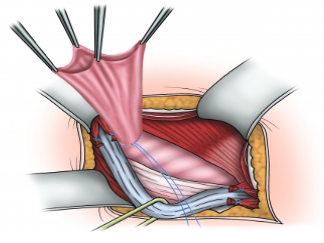 Your surgeon will make an incision (cut), usually over your hernia bulge. The piece of intestine or other structures bulging through your hernia is returned to the abdomen and the opening is closed with sutures. Sometime the muscle wall around your hernia is strengthened by placing sutures and by a mesh to prevent the hernia developing again. This operation can be performed under local, spinal, or general anaesthesia.
Keyhole repair (Laparoscopic surgery).
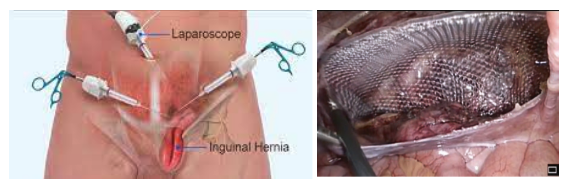 Your surgeon usually make 3 small incisions on your belly on different sites. He or she will insert a laparoscope (tiny telescope) into one of these incisions (mostly around belly button) and use instruments to reduce hernia inside the abdomen and uses a synthetic prosthesis (mesh) to repair your hernia. This operation is performed under general anaesthesia.
Am I suitable for Keyhole (Laparoscopic) Repair? Your surgeon will determine whether an open or laparoscopic hernia repair is suitable for you after clinical examination.
A hernia is usually repaired under either:
- General Anaesthesia (a state of carefully controlled and supervised unconsciousness that means you are unable to feel any pain)
- Spinal Anaesthesia (where you are awake but have an injection in your back that numbs the lower part of your body).
What are the benefits of having the operation?
The benefits of having an operation include:- Improve the symptoms of pain and discomfort caused by the hernia.
- Improve quality of life, so you can return to your normal activities.
- Prevention of bowel ischaemia which is serious condition that includes having dead bowel (gut). If this to happen, you may require emergency surgery and removal of the dead bowel.
- Improve physical appearance
Are there any risks or complications with surgical repair of a hernia?
As with all surgical procedures there are risks involved but steps are taken to minimise (reduce) these.Short term risks and complications may include:
- Bleeding. You may develop bleeding inside your groin or from your wounds post operatively. A collection of blood can sometimes develop at a wound site. This may require drainage.
- Allergic reaction. This can be to the equipment, materials or medication. Let your doctor or nurse know if you have any allergies or if you have reacted to any medication or tests in the past.
- Infection. If you feel feverish or your wound becomes inflamed (hot and red) and sticky, you should seek help. This can be treated with antibiotics. You may develop mesh infection. If this were to happen, you would develop increased pain or discomfort. You can be treated with medication, but if it does not settle the mesh may have to be removed.
- Injury to surrounding structures. These can include bowel, bladder and blood vessels.
- Recurrence of your hernia. There is a chance that a hernia can recur. This occur in a small minority of patient. Long term outcome of hernia recurrence depends mostly on your early activities immediately after operation.
- Retention of urine. After surgery, a small number of patients may find it difficult to pass water immediately after surgery. If this does happen a urinary catheter may need to be passed to empty your bladder. This would be removed before you are discharged home.
- Chronic pain/numbness. This can be felt in the groin region.
- Scarring. This can happen at the incision site/s, dependent on the type of surgery (Keyhole or open repair).
- Fluid collection. Male patients may experience a build-up of fluid in the scrotum (testicles). This commonly improve with time, very rarely you may need an operation to treat this.
- Loss of testicle. This is incredibly rare (<1:500). Depending on the extent of this you may need to return to theatre.
- Deep vein thrombosis (DVT). DVT is blood clots in the leg veins.
- Pulmonary embolism (PE). Blood clots in the lungs. DVT and PE will need treatment with blood thinners if they occur.
Will I be in discomfort after my operation?
You may have:- Discomfort at your wound sites. Taking painkillers at regular intervals works best, rather than waiting until you are in pain. It will also reduce the need to take stronger painkillers. Always follow the instructions provided in the leaflet supplied with your tablets.
- Nausea (feeling sick) or vomiting (being sick) because of the anaesthetic. These will usually settle within 24 - 48 hours. It is important to drink plenty of fluids, but not alcohol, to avoid dehydration.
- It is normal to feel tired for 24 - 48 hours after your operation.
Facts following the operation
When should I call my doctor?- Persistent fever
- Bleeding
- Increased abdominal pain
- Pain that is not relieved by mediations
- Persistent nausea and vomiting
- Inability to pass urine
- Persistent coughing or shortness of breath
- Purulent drainage (pus) from incisions
- Redness or discoloration of skin around surgical site
When can I have a bath or shower again?
During the first week after your surgery you are advised not to soak in the bath. This is to help avoid a wound infection. Showering is advised.When can I have sex again?
You may have sex again when you feel comfortable unless you have been advised not to by your doctor.When can I drive?
You may drive as soon as you feel comfortable and can carry out an emergency stop. You should check with your insurance company and the Driver and Vehicle Licensing Agency (DVLA) for their advice on driving after k surgery.When can I return to work?
You may need to take 1 - 2 weeks off work. This will depend upon the type of work you do.When will I be able to exercise?
You must not carry any weight more than 10 % of your body weight for 4 weeks and you should also not do any heavy lifting for another 2 weeks or more after your operation.What if I choose not to have surgery?
Your hernia may stay the same and not cause you any problems.You may decide to try using a truss to relieve your pain or discomfort.
However, your hernia is likely to become steadily worse as time goes on.
You may find lying down or putting gentle pressure on the swelling with your hand will relieve discomfort for a short while by reducing your hernia (pushing your bowel back into place).
If your hernia reduces it is not dangerous, but your pain or discomfort may continue if it is not repaired.
If it cannot be reduced it may have become strangulated. If this happens you must seek urgent medical advice.